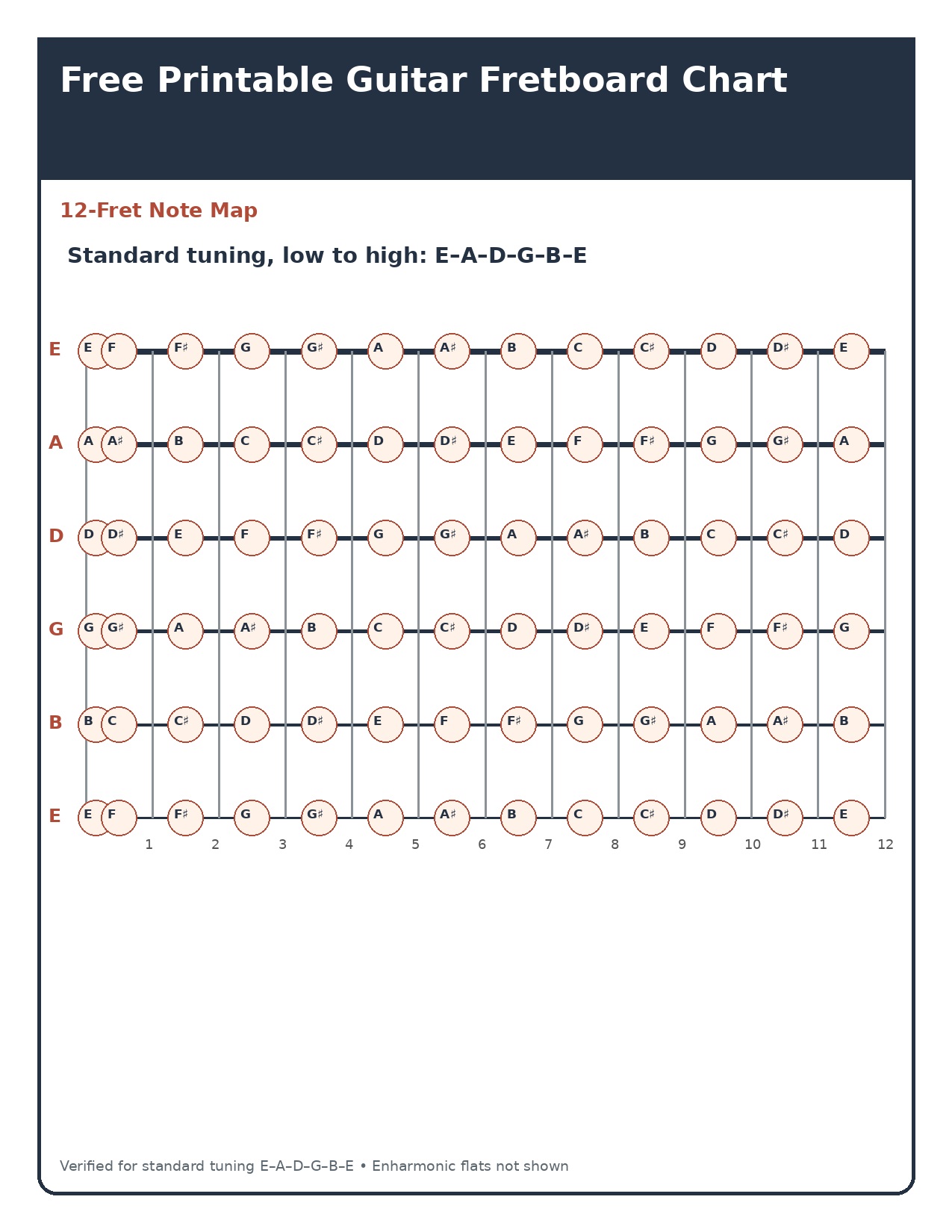
A useful free printable guitar fretboard chart must get the string order and semitone pattern right. These charts use standard tuning from the sixth string to the first: E–A–D–G–B–E. Each fret raises a string by one semitone, and the 12th fret repeats the open-string note one octave higher.
Three verified fretboard charts
12-fret guitar note map
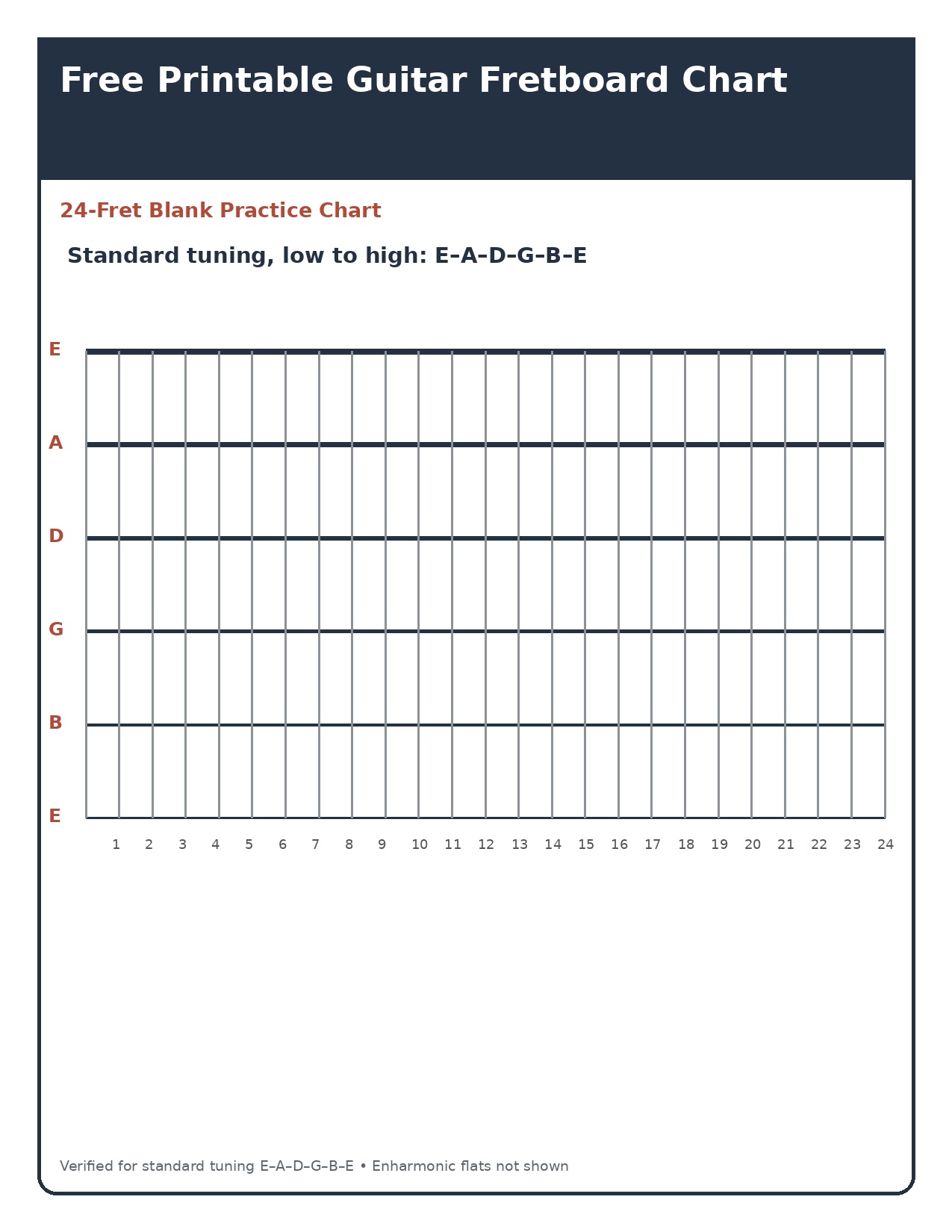
Blank 24-fret practice chart
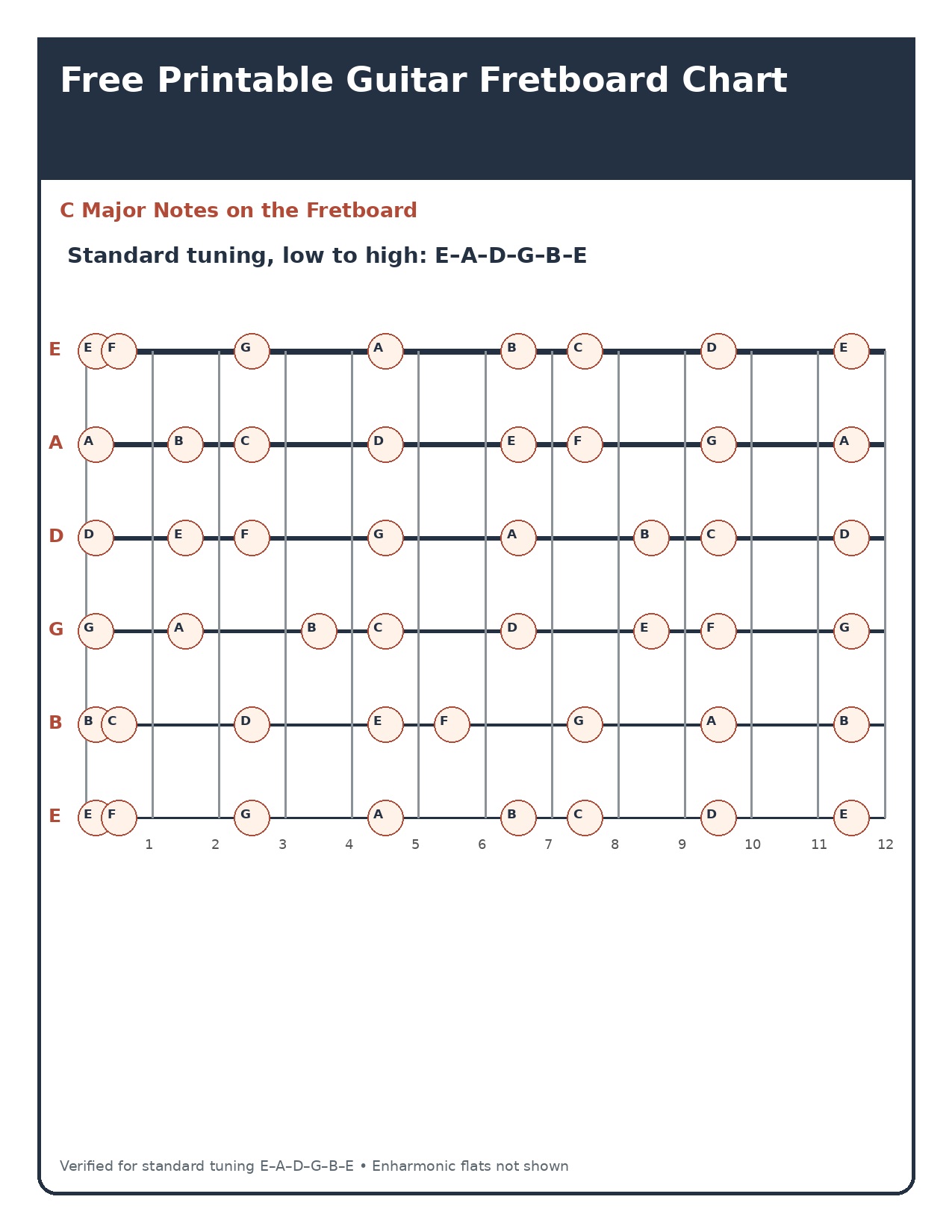
C-major notes on the fretboard
How to read the note map
Each horizontal line is a string; the thickest/lowest string is shown first. Move one fret to the right to advance one chromatic note. The chart uses sharps for black-key spellings, so A♯ may be called B♭ in another musical context.
Practice routine
- Memorize the open strings: E, A, D, G, B, E.
- Find every natural note on one string.
- Use octave shapes to locate the same note elsewhere.
- Write one scale on the blank 24-fret chart.
- Say each note aloud while playing slowly with a metronome.
Why the C-major map helps
C major contains C, D, E, F, G, A, and B—no sharps or flats. Highlighting those notes makes the whole-step and half-step pattern easier to see without displaying every chromatic pitch at once.
FAQ
Does the chart work for left-handed guitar?
The notes are the same, but you may prefer rotating the page or using a mirrored visual orientation depending on how you view the neck.
Why do notes repeat at fret 12?
The 12th fret divides the vibrating string length in half, producing the same note name one octave higher.